
Motion AI
A neural network recognizes exercises from sensor data in real time and counts repetitions.
Inside the product
Project and context
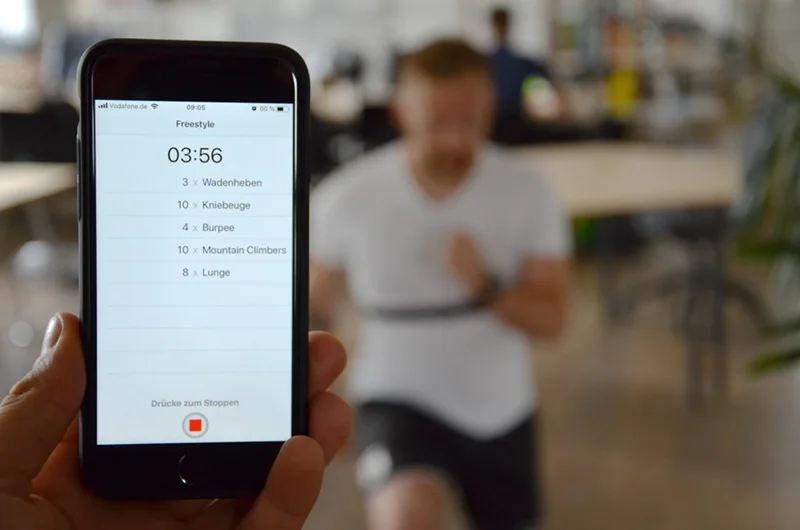
Motion AI is a deep learning technology that recognizes human movement from sensor data. Using a single chest-strap sensor, we distinguished up to 20 bodyweight exercises in real time, counted repetitions, and derived information about movement quality.
We later expanded the technology for gaming. Jumps, ducks, and lateral movements could control characters on an iPhone with low latency.
Motion AI was originally designed as a licensed product for fitness apps and other providers.
My role
As CTO, co-founder, and managing director, I helped build Evomo and brought Motion AI from its foundations to market with an interdisciplinary team. At its peak, the company involved up to nine people.
I held overall technical responsibility and implemented a large part of the technology myself, including recording and labeling tools, training-data management, model training, the cloud pipeline, and the iOS and Android SDKs.
With backing from an investor, we later expanded the technology for gaming. We presented the resulting fitness gaming app on German Shark Tank in 2021.
Technical foundations
The movement recognition is based on deep learning. Acceleration and orientation data are captured as time series, labeled, and used to train specialized models.
The models ran entirely on the mobile device. Custom SDKs made the technology available on iOS and Android. A cloud pipeline managed and distributed trained models, while recognition itself required no cloud connection.
The central technical challenges
Training required a large movement dataset from a broad group of participants. Sports scientists supported data capture and the domain-specific classification of exercises.
Labeling was particularly demanding. We developed tools that visualized sensor data and partially automated the process, followed by manual correction and fine-tuning.
The models had to remain accurate while running with low latency on smartphones and wearables. We also had to package and update them through our own iOS and Android SDKs.
Results and evidence
Motion AI recognized more than 20 exercises with an accuracy of over 95 percent. We delivered the technology as SDKs for iOS, watchOS, and Android and used it in several of our own products and client projects.
In 2019, Motion AI won the Movesense Innovation Contest against more than 30 participating teams. Its later expansion into gaming formed the technical foundation of our own fitness gaming app, which we presented on German Shark Tank in 2021.
My perspective
For me, Motion AI marked the step from individual ML models to a complete, market-ready technology. The key was combining training data, custom tooling, mobile SDKs, and reliable on-device execution.
The technology is still being developed and used in real products today.